|
|
||||
|
Find
out more: Take a surreal seaside walk |
||||
|
|
||||
|
||||
|
|
|
|
|
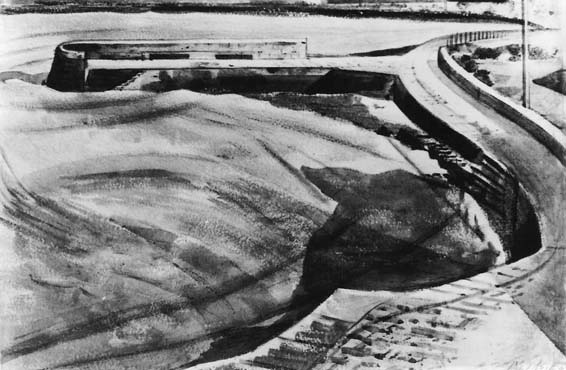
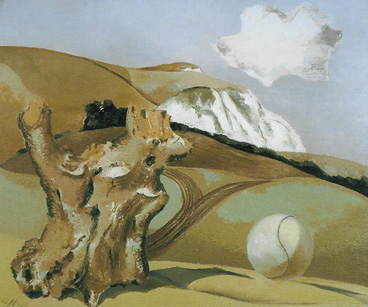
Start the walk from the Heritage Centre, The Square, Swanage (SS = references to illustrations in Pennie Denton's book Seaside Surrealism: Paul Nash in Swanage.) Turn left to walk along The Parade. Stop outside No 2. This is where Paul Nash lived for most of 1935. He had come to Swanage in October 1934 to stay at Whitecliff Farm, which is situated just behind the houses and hotels of New Swanage. Look to the north along the beach and you may just be able to see the stone farmhouse on the left behind the Grand Hotel. From his living room/studio on the first floor of No 2, The Parade Nash painted a number of works featuring the Quay (on your right), and Ballard Head (the furthest point on your left).(See SS pages 27,28, 29, 40, 41) Continue along the Parade, past the Mowlem Theatre and along the sea front until you reach the Alfred the Great Monument. In his Architectural Review article of 1936 'Swanage, or Seaside Surrealism' Nash imagined a shipwrecked stranger 'struggling towards the shore through angry waves on a dark night.' He wanders down the deserted esplanade 'until a stone column surmounted by a pyramid of cannon-balls set askew looms in his path. Reading the inscription that this monument was raised to commemorate King Alfred's Victory over the Danes, he becomes convinced that his reason has left him or that he is merely part of a dream.' (See SS page 30. ) The monument was moved further along the sea-front to the north in the 1960s when the new Mowlem Theatre was built. (SS page 80. ) Five of the benches admired by Nash, and designed by Swanage Urban District Council, lurk forlornly in the bandstand in the gardens on the other side of Shore Road. (See SS page 80) Retrace your steps to the Mowlem Theatre, this time passing it on your left, and proceed straight ahead up Institute Road. At the junction turn right up the High Street until you reach the Town Hall. Nash calls it a 'Wren façade of bad but genuine design grafted onto the late nineteenth century Town Hall.' Current opinion has it that the façade, which was brought to Swanage by George Burt from Mercer's Hall in London, is by Wren's pupil Edward Jerman. Continue up the High Street past the Purbeck House Hotel. George Burt bought Purbeck House, then a simple Georgian house, and in 1875 rebuilt it in a Scottish Baronial style, embellishing it with the spoils of his London demolitions. His architect was G.R.Crickmay of Weymouth. Pevsner wrote 'The style is High Victorian at its most rebarbative, and the position right beside the pavement makes it impossible to avoid those crazy-paving walls, those stepped gables, that octagonal turret, and all those bay windows.' A suitable palace for the 'King of Swanage.' Continue up the High Street and turn left up Chapel Lane just after the Methodist church. At the top of the alley behind a high stone wall is Clarence Cottage. In the summer of 1935 the painter Eileen Agar and her partner Joseph Bard rented this cottage. During that summer Eileen and Paul frequently met for walks and talks about painting and developed a close friendship that became a love affair. Continue up the hill past the hospital and take the second road on the right - Russell Avenue. In Russell Avenue take the first left, Russell Drive, a gravel road between modern houses which eventually turns into a path between high hedges as it descends. This is Donkey Lane, named after the donkeys who carried stone from the quarries to Swanage. Behind the wooden fence of the last house on the right is a new house recently built in the grounds of Scar Bank House. Scar Bank House was built in 1925 by the architect Morley Horder for Archibald Russell. Archibald Russell, Clarence Herald, entomologist and connoisseur, and his wife, Janet, became close friends of the Nashes. If you look back when you get to the end of the track you will be able to see Scar Bank House, only slightly altered by subsequent owners. (SS page 20, 21, 22, 62 Colour plates 2, 5, 6) |
|
A waiter in town had suggested to Nash that Durlston Castle was a good objective for a walk. He imagined it to be a picturesque ruin but as he approached the headland he discovered it to be 'a solid structure of turrets and castellated walls.' Further surreal experiences lay in wait. Walk past the castle and down with castle wall on your left, reading the educational tablets on the wall as you go. A path continues to the right but take the one just to the left of the main path and you should find yourself close to the Great Globe. Nash knew that George Burt was the inspiration behind the mysterious castle and other objects at Durlston Head and that he was 'responsible for transferring to Swanage the useful and ornamental oddities acquired in the course of his transactions in London.' 'Undoubtedly' wrote Nash 'the Great Globe and Durlston Castle were his masterpieces.' The Castle, incidentally, was designed for him as a tea-room and restaurant by G.R. Crickmay. Return to the Castle and follow 'Coastpath' sign on to the wide path, which runs along the top of the cliff above Durlston Bay. Pass the car park on your left. Continue along this path enjoying the views to Peveril Point, Old Harry and Bournemouth through the trees. You are walking along Pinecliff Walk, or Isle of Wight Road, part of Burt's grand design to turn the Durlston cliff area into a natural park and Durlston inland into an exclusive residential area. Continue along the coast path. You will need to divert to the left where the path is blocked because of a cliff fall. At Durlston Road turn right and upwards. Take the first right into Bellevue Road and follow it round until you reach the top of the Downs. Turn right and walk down the Downs, staying by the cliff, to Peveril Point. At Peveril Point take the path along the sea's edge back into Swanage past the Coastguard Cottages and Life Boat house. Before you is the Clock Tower. Nash saw the 'huge clockless tower' as a 'repulsive Victorian-Gothic structure, grey and papery against the solid sea, standing in the remains of a villa garden'. It was, of course, one of Burt's most eccentric and extravagant gifts to his home town. Built as a memorial to the Duke of Wellington, it had been erected by London Bridge. Road widening schemes made it redundant and although Nash found it repulsive, he photographed and painted it several times. (SS Title page) Continue along the path under the Clock Tower and then up the steps to the garden above the little beach ahead. Where you stand at the top of these steps was the terrace of the Grosvenor Hotel. Grove House had been built in 1838 as a private house but early in the 20th century it became a very grand hotel. Now, regrettably, the 'garden' hides a sewage plant. Try to forget this and imagine yourself on the terrace of the Grosvenor with the hotel behind you and Swanage Bay before you, as it was in 1935. For it was here that Ashley Havinden, a poster designer, introduced Eileen Agar to Paul Nash. It became, for Nash, a magical summer as he and Eileen wandered along the beach collecting found objects and he introduced her to the surreal aspects of Swanage. 1935 was a great year for Nash; a year when anything seemed possible and he produced more creative work than ever in his career. (SS p 46) Follow the path towards town, diverting for a stroll along the Pier if you wish. Then continue along the stone path by the sea's edge until you are back at the Heritage Centre. |