|
 |
 |
 |
 |
|

| |||||||||||||
|
|
Article for Robert Horne magazine
(Distributed to designers and print specifiers) I have been responsible
for editing many issues of 'Unfold', a 24 page magazine designed to provide useful
information to designers and print specifiers. Some copy I translate from techno-jargon,
and some pieces I originate. This article was written following interviews with
a couple of printers and a designer/specifier. It is perhaps worth noting that
my knowledge of print is not extensive - unlike that of the commissioning agency,
Marketing Matters.
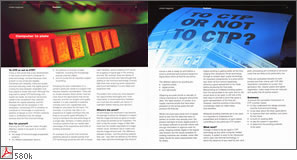
Text of extract shown above To CTP or not to CTP? There is little doubt that the future of print lies in computer to plate technology, not least because most artwork is now produced digitally. Combined with increasing reliability, steadily improving quality and ever reducing costs, the digital goal of closing the loop between origination and final output is closer than ever. Although the argument to adopt CTP technology can readily be made, its practical introduction needs to be considered very carefully. Besides the capital expense, and the changes that will be necessary in the workplace, introducing CTP is certainly no substitute for knowledge or experience, whether of design or print. Printers certainly need to understand fully the design process and the front-end technology.
Planning for CTP requires careful thought. Attention needs to be given to a number of things:
Choosing the best combination for a printer's particular needs is a subject that requires detailed consideration. There are no simple answers. Each printer must be clear about the applications that will be required, and the run-lengths and quality needed. It is also essential to examine critically one's own capabilities and limitations, and plans for the future. For example, if a printer has little or no experience of computer design they are likely to encounter great difficulties in trying to introduce the new technology at a single step. Similarly, it makes sense to introduce systems that can readily take advantage of the experience and skills of existing employees. An example of a printer that would be perfectly placed to benefit quickly from CTP technology would be one with an in-house design studio and its own repro facilities, where installing CTP would be plugging a logical gap in the printing process. By contrast, there are stories of conventional printers who have thought that adding on the front-end technology involved little more than acquiring some equipment - and found themselves in a very deep and expensive hole. The bottom line is that you must research the opportunities thoroughly and, most importantly, to avoid expensive mistakes you must see any system you favour in operation before making your decision. As technology has advanced it has become increasingly common for designers to expect that the image that looks so good on screen can simply be printed out as it appears. - whether designing for computer to plate or computer to film. The truth is that the screen image is often little more than the modern equivalent of a magic marker visual. Someone has to make sure that the image will print well. The difference between printers - and the proofing systems they use - may often be defined by the efforts they make (and the knowledge they have) to ensure a disk is ready for print before a proof is produced and everyone begins to argue about who's at fault for any errors.
Obtaining accurate proofs is naturally of critical importance to designer and printer alike. The ideal solution, of course, is to supply machine proofs that have been prepared on the actual press that will produce the final job. But with CTP this could cost twice as much as proofing in the conventional film to plate process. Whilst one must have some form of digital proof to see how the data that looks so perfect on screen may actually print, the present standard of digital proofs is not always sufficient to provide clients with enough information to approve work for press. Keeping entirely digital is the logical way forward, but the results available on existing machines are variable: some offer better results for some requirements than for others. Digital proofing is getting better all the time, ranging from advanced ink-jet technology (such as digital Chromalins) through to simpler laser copier technology. An important characteristic is a proof which lays down all four colours separately, allowing a good assessment to be made before producing the final plate. Wet-proofing on a flatbed proofing system, from the actual plate to be used, and on the actual stock to be used, is still one of the best ways to provide a proof that gives a good representation of the final job. However, machine proofing is becoming increasingly viable as make-ready time shortens. Whatever
proofing methods are to be used, it is important to understand the possibilities
and limitations of each before committing to any particular CTP system. What next? Change is likely to be as rapid in CTP technology
as in any other computer related industry. Whatever happens, CTP can only become quicker and more economical for all involved. Printers will save time (and money) and designers will get results that deliver the quality they expect.
To ensure the successful introduction of CTP, a printer needs:
| ||||||||||||
 |